Tents & Shelters for Wet Northwest Nights
Rainfly coverage, ventilation and pitch-in-the-rain designs that keep you dry from the coast to the Cascades.
Your tent is the one piece of gear that decides whether a rainy night in the Pacific Northwest is a minor inconvenience or the reason everyone drives home at 2 a.m. West of the Cascades, rain is not an "if" for much of the year, and even midsummer brings marine fog that drips off the canopy like a slow shower. Choosing a shelter here is less about shaving grams and more about how well a design sheds water, manages condensation and lets you set up without soaking the inside.
This guide walks through the features that matter most, what to check in a store or on a spec sheet, and the habits that make any decent tent perform better in our climate.
Start with how you camp
Before you compare fabrics, be honest about the kind of trips you take. A tent that is perfect for car camping at a state park on the Oregon coast can be miserable to carry up a trail in the Olympics, and a minimalist backpacking shelter can feel cramped when you are waiting out a full day of rain at a drive-in campground.
- Car camping and drive-in sites: weight barely matters. Prioritize livable space, near-vertical walls, large doors and a generous vestibule or a separate tarp for a dry hangout area.
- Backpacking: balance weight with weather protection. A semi-freestanding double-wall tent is the most forgiving choice for mixed forest and alpine terrain.
- Bike and paddle trips: pack size and short pole segments matter, and a tent that pitches fly-first keeps the interior dry while you set up on a gravel bar or a coastal hiker-biker site.
Capacity ratings assume people lying shoulder to shoulder with nothing else inside. In a rainy region, where you may spend hours in the tent, many campers size up by one person or choose a model with a large vestibule.
Rainflies, walls and the double-wall question
Full-coverage flies
Look for a rainfly that extends close to the ground on all sides. Partial "cap" flies that leave the upper mesh exposed are fine in dry interior climates but let wind-driven rain splash in along the coast. A full fly also traps a layer of air that keeps you a little warmer on damp nights.
Single wall vs. double wall
Single-wall tents are light and quick to pitch, but in cool, humid conditions the inside of the wall collects condensation that you will brush against all night. Double-wall tents, with a breathable inner tent and a separate waterproof fly, handle this far better. For most Northwest campers, especially newer ones, double wall is the safer bet.
Fabric and coatings
Fly fabrics are commonly coated with polyurethane, silicone, or both. Silicone-coated fabrics tend to be stronger for their weight and shed water well, though they can stretch slightly when wet, so you may need to re-tension guylines after dark. Polyurethane coatings allow seams to be factory taped. Either can work; what matters is that the seams are sealed and the coating is in good shape.
Ventilation is your best defense against "rain" inside
Many people who think their tent is leaking are actually seeing condensation. A sleeping adult releases a surprising amount of moisture overnight, and when the air outside is already near saturation, that moisture has nowhere to go but onto the cold fly. Good ventilation does not eliminate condensation, but it dramatically reduces it.
- Choose a fly with high vents that can be propped open and stay protected from rain.
- Look for doors with a two-way zipper so you can open the top of the fly while keeping the bottom closed.
- Make sure the fly can be staked out taut so it does not sag onto the inner tent.
- Prefer inner tents with a mix of mesh and solid panels; full mesh breathes best but lets more cold air and spindrift in on the shoulder seasons.
Pitch with a door facing the breeze if you can, and never seal every vent to "stay warmer." A slightly cooler, drier tent is more comfortable than a warm one with water running down the walls onto your sleeping bag.
Floors, footprints and ground choices
A "bathtub" floor, where the waterproof floor fabric rises a few inches up the walls before meeting the mesh, keeps pooled water and splash out. Check that floor seams are taped. Higher denier floors resist abrasion from gravel pads and roots but add weight.
A footprint or ground cloth protects the floor and keeps it cleaner. The key rule is simple: the footprint must be slightly smaller than the tent floor. If it sticks out, it catches rain and channels it straight underneath you.
Site selection does more than any fabric. Pick slightly raised, durable ground, avoid shallow depressions that will become puddles, look up for dead branches, and use established tent pads where they exist to protect fragile understory.
Poles, stakes and pitching in the rain
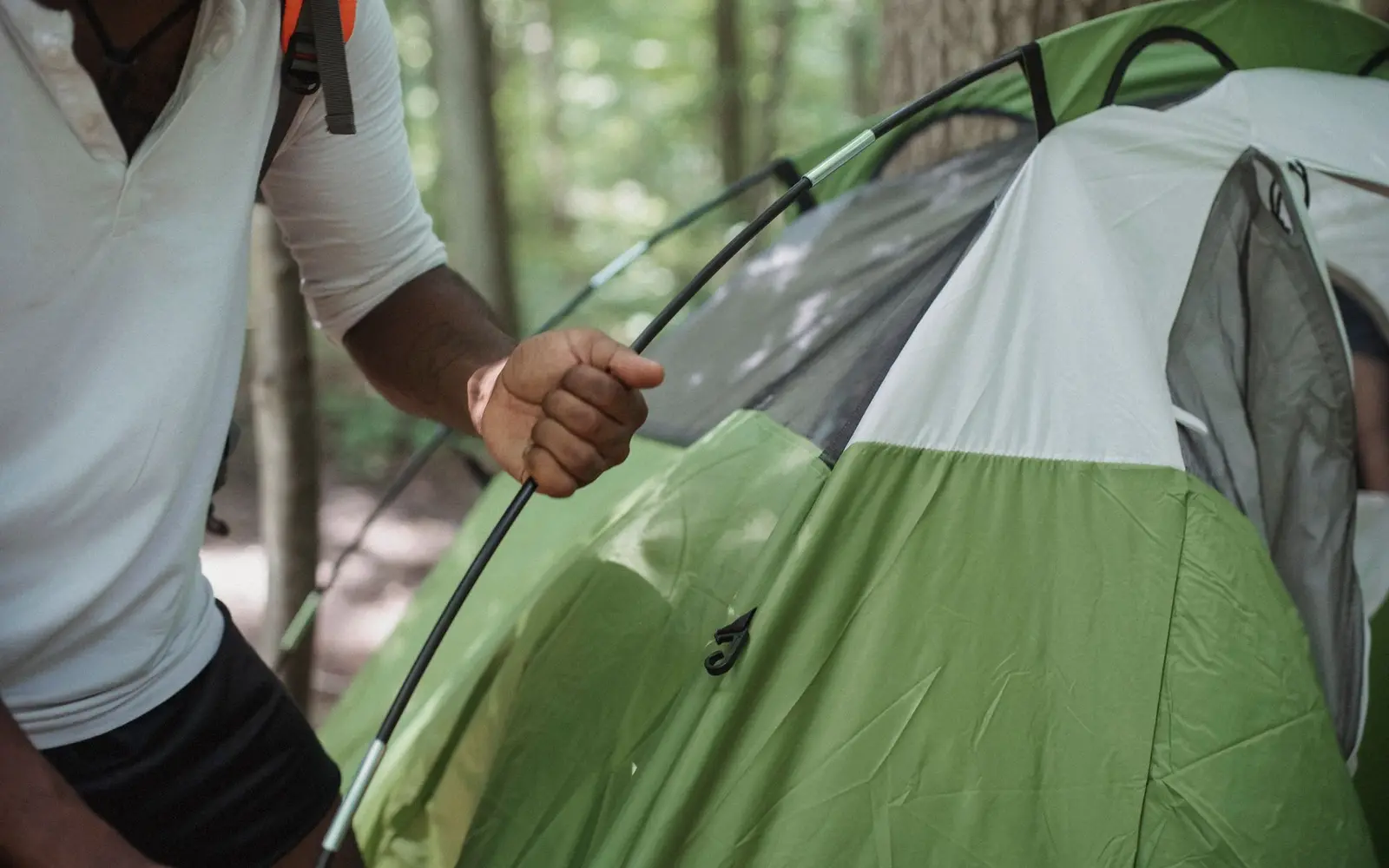
Aluminum poles are the standard for good reason: they flex, they are repairable, and they handle wind well. Hubbed pole systems and color-coded clips make setup faster when your hands are cold and the light is fading.
The design detail that matters most in our region is how the tent goes up when it is already raining. Some tents allow you to pitch the fly first, with or without a footprint, and then clip the inner tent in underneath. Others let you keep the inner tent attached to the fly so both go up together. Either approach keeps the sleeping area dry. Practice at home once, so the first time is not in a downpour.
Default stakes are often thin wire. Forest duff and sandy coastal soil reward longer, wider stakes, and rocky alpine ground may call for a few tie-out loops you can anchor with rocks.
Tarps and other shelter options
A simple rectangular tarp is one of the most useful items in a Northwest kit. Strung above a picnic table or between trees, it creates a dry kitchen and hangout space so you are not cooking or sitting in your tent. For backpackers, a tarp paired with a bivy or a bug net can replace a tent entirely, though it takes practice to pitch well in shifting wind.
Whatever shelter you choose, use guylines. They stabilize the structure, pull the fly away from the inner tent and help shed water. Reflective cord is easier to see at night, and a couple of simple tensioners save frustration.
Care that keeps a tent waterproof
- Shake out debris and wipe the floor before packing.
- Never store a tent damp; dry it fully at home within a day or two to prevent mildew and coating breakdown.
- Store it loosely in a breathable bag rather than tightly compressed.
- Check seam tape each season and reseal spots that are lifting.
- Refresh a tired water-repellent finish on the fly when rain stops beading.
A mid-range tent that is pitched well, ventilated thoughtfully and cared for between trips will outperform an expensive one that is set up in a hollow and stored wet. Start with a design that sheds water and manages condensation, learn it at home, and it will serve you from the dunes to the high lakes.